
The history of Mangal Nath Mandir Ujjain
Mangal Nath Mandir is one of the oldest sites of worship in Ujjain and the only major temple in India traditionally revered as the birthplace of Mangal — the graha known as Mars. Its history sits at the meeting point of Puranic account, the astronomy of ancient Ujjain, and an unbroken tradition of worship on the bank of the Kshipra.
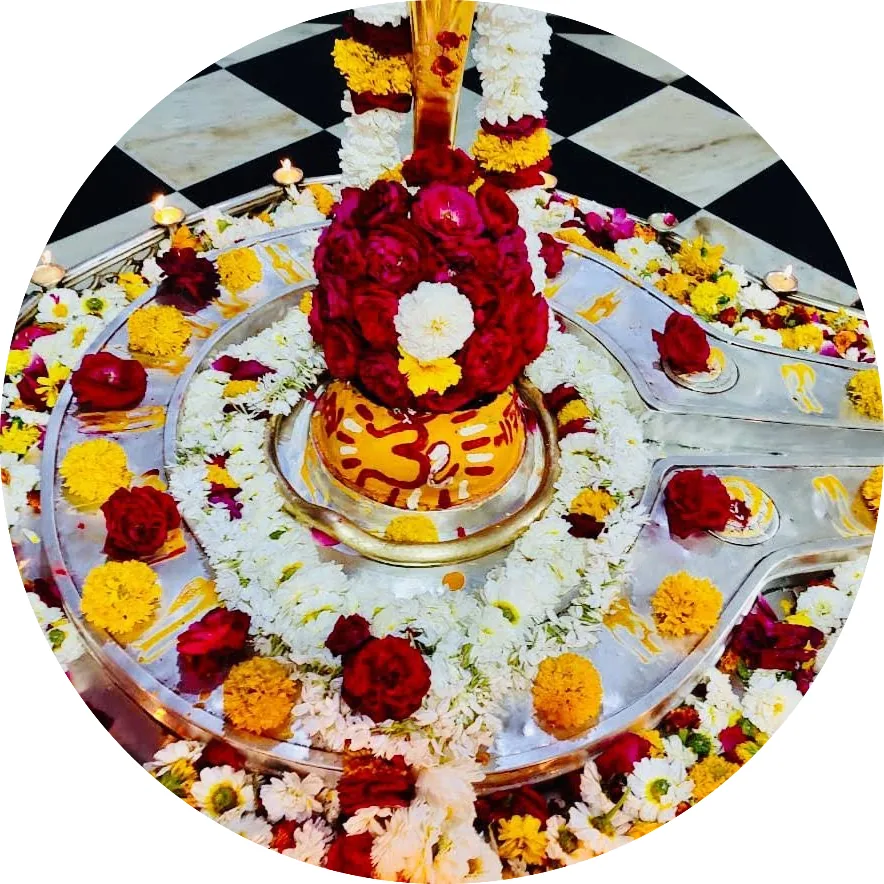
The Matsya Purana account
The account that gives this temple its identity is preserved in the Matsya Purana. It concerns the asura Andhakasura, who had received a boon of a peculiar and dangerous kind: every drop of blood that fell from his body to the earth would give rise to another asura exactly like him. An ordinary battle against such an adversary could not be won, since every wound multiplied him.
Lord Shiva contended with Andhakasura at this place. The Purana relates that the exertion of that long struggle caused drops of sweat to fall from Shiva’s forehead onto the ground below — and that from that ground Mangal, the planet Mars, took birth. The site of that birth is the ground on which Mangal Nath Mandir stands.
Two details of the account are worth noticing. The first is that Mangal is born of Shiva’s own exertion, which places the graha in a direct relationship with Mahadev rather than in opposition to him — the reason the ancient Shiva linga within this complex is worshipped alongside Mangal Dev. The second is the reddish cast of the soil in this part of Ujjain, which local tradition has long connected with the birth of the red planet at this spot.
Ujjain and the measurement of the heavens
That a temple to a graha should stand in Ujjain, and not elsewhere, follows from what this city has been for a very long time. Ujjain lies close to the Tropic of Cancer, and in the Indian astronomical tradition it was treated as the prime meridian — the zero line from which the positions of the planets were reckoned. Calculations of time, of the calendar and of planetary movement were made with reference to this city.
Ujjain was, in other words, the seat of kaal-ganana and of jyotish. A person seeking to address the influence of a graha in the kundli came to the place where that graha’s position was itself defined. The presence of Mangal Nath Mandir here belongs to that older logic, and it explains why a Manglik kundli has customarily directed a family towards Ujjain for generations.
The temple on the Kshipra
The temple stands on the bank of the Kshipra, the river around which the sacred geography of Ujjain is arranged. The ghats of the Kshipra are where the Simhastha Kumbh gathers every twelve years, and the river itself carries the ritual importance that permits the snan and tarpan which accompany many anushthan.
The present structure has been repaired and rebuilt across the centuries, as temples of this age generally have been, and no single date can be given for the building now standing. What has been continuous is the worship. The complex today holds the ancient Shiva linga, the shrine of Mangal Dev, and the open ghat-side space in which puja is performed.
The tradition maintained today
Worship at Mangal Nath Mandir is carried on by the temple’s pandit ji in the parampara maintained here, currently by Mahant Akshay Bharti and Mahant Rajendra Bharti. The anushthan performed at the temple — Mangal Dosh Nivaran Puja, Bhaat Puja, Kaal Sarp Dosh Puja and Navagraha Shanti Puja — are conducted with the full Vedic vidhi and in the yajman’s own name and gotra.
Tuesday remains the day of Mangal Dev, and the temple is at its busiest then. Bhaumvati Amavasya, when an Amavasya falls on a Tuesday, draws the largest gatherings of the year outside the Simhastha period. Devotees continue to arrive from across India and from NRI families abroad, most of them making the visit alongside darshan at Shree Mahakaleshwar Jyotirlinga.
On sources. The account of Mangal’s birth given above follows the Matsya Purana as it has been transmitted in the tradition of this temple. Puranic history is a matter of shraddha and is recorded here as the temple relates it.
Visiting the temple
If you are planning to come, the practical details are set out on the darshan and puja timings page and the how to reach page. To have an anushthan performed, see the puja page or speak to the temple pandit ji directly on +91 9826690556.